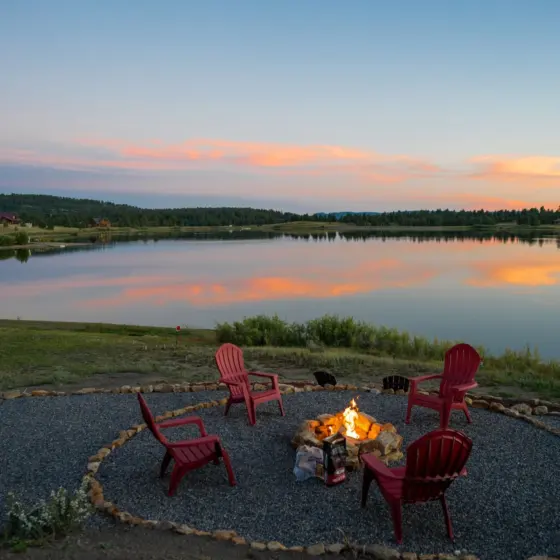
Pea gravel fire pit ideas work best when the gravel is a thin top layer over a level, free-draining base, the burn chamber uses suitable stone, and seating sits well back from the flames.
The sections below follow the build in order: how the material behaves, the base, layouts, seating distances, planting and cost. For the wider yard context, see our guide to patio ideas with plants.
How pea gravel behaves around a fire
Pea gravel is popular because rounded stones let water pass through and need only a level bed beneath them. That makes it a cheap, forgiving ground surface for a fire area. The same roundness explains its main drawback. A Massachusetts landscaping contractor points out that pure round pea gravel shifts under chair legs, so chairs can sink or move on loose stone.
Is pea gravel safe around a fire pit? Yes as a ground surface, which is how it is used in both DIY tutorials and contractor designs. The condition is what sits inside the burn chamber. The same contractor advises avoiding porous river rocks or soft shale inside the burn chamber. Keep the gravel as the surround and base, build the burn zone from a purpose-made fire ring or pit wall, and check your local open-flame rules before lighting anything.
Building the gravel base in stages
A gravel fire area is only as stable as the layers beneath the top stone. The contractor’s layered approach and the simple weekend approach differ mainly in how much work goes below the pea gravel.
- Pick the spot. A DIY tutorial advises choosing an area that doesn’t normally puddle with water. Another recommends a flat or nearly flat surface, or having the area leveled.
- Excavate. The contractor’s method is to excavate 4 inches of topsoil and keep the subgrade level.
- Lay fabric. Use 4-ounce non-woven geotextile, which stops weeds without trapping moisture.
- Add the stone base. Spread 2 inches of 3/4-inch crushed stone as a stabilizing layer. Angular stone locks together, which is why it makes a firmer footing than round gravel.
- Top with pea gravel. Finish with 1.5 inches of washed pea gravel.
How deep should the gravel base be?
| Build style | Gravel depth | Planning use |
|---|---|---|
| Contractor layered circle | 2 inches of 3/4-inch crushed stone plus 1.5 inches of washed pea gravel | Suits a patio-style circle where chairs will stand, because the stone layer gives firmer footing |
| Weekend DIY ring | Approximately 2.5 inches of pea gravel | Suits a simple, lightly used ring on ground that already drains well |
Depths come from a Massachusetts contractor’s design guide and a DIY fire pit tutorial.
Another DIY fire pit area is about 3 inches deep. Read these as the depths used in finished projects, not as a code minimum. If you want chairs on the gravel, put the extra effort into the layer below it rather than simply piling on more pea gravel.
Draining a gravel fire pit area
Drainage starts with the site, not the stone. Level ground gives even footing, but water still needs somewhere to go. The contractor’s design list includes positive slope drainage that prevents pooling water beneath footings. Combine a nearly flat surface with a gentle fall away from the pit, and leave out low spots that hold water after rain. Non-woven fabric lets moisture move through while keeping the gravel clean of weeds, so it supports drainage rather than blocking it.
Layout ideas that suit gravel
Gravel suits a few distinct layouts, and the right one depends on how many people you want to seat and how much you want to spend.
Compact ring in a wide gravel field
One DIY project built a fire pit 4 feet in diameter inside a 20-foot diameter gravel area. A small pit with a large surround keeps the fire contained and leaves plenty of room for furniture to be moved back as needed. This is the lowest-effort layout and works for most casual yards.
Rustic gathering circle
The contractor’s rustic pea gravel circle runs 14 to 16 feet across. It uses the layered base above and reads as a deliberate patio rather than a patch of stone, so it suits yards where the fire area is a focal point.
Chair pads in loose gravel
Chair stability is the common complaint, and the contractor’s fix is to use angular crushed stone dust or to embed flat bluestone stepping stones under each chair’s contact points. Stepping stones also make a natural ring of seats that doubles as a visual pattern in the gravel.
Seating distances and clearances
How far should seating sit from the fire? The supplied guidance is framed around overall circle size and clear space rather than one fixed number, so plan the whole circle first and place chairs inside it.
- Overall size. The contractor recommends a minimum patio diameter of 14 to 18 feet, giving 7 to 8 feet of radius from the fire center.
- Clear space on pavers. For a paver patio, allow at least 48 inches of smooth paver field between the fire pit wall and the chairs. That figure is for pavers, so use it as a sensible starting point if you edge your gravel with a paved ring.
- Walkway behind chairs. Keep an unobstructed 3-foot perimeter behind the chairs so people can pass without stepping into the fire zone or the seating.
- Seat count. A fire pit area 16 feet in diameter was described as suiting 6-8 Adirondack chairs.
If your yard is smaller than these sizes, choose fewer chairs and a smaller pit rather than squeezing seats against the fire. Furniture that folds or lifts easily also helps. If the fire area will sit near a deck or screened seating zone, our guides to Backyard Privacy Ideas: Smart, Stylish Ways To Create Seclusion In 2026 and Budget Backyard Deck Ideas: Practical, Stylish Ways To Build And Style Your Outdoor Space In 2026 cover the surrounding space.
Planting around the gravel
Heat-resistant plants belong at the edge of the design, not beside the chairs. The contractor specifies fire-safe, non-resinous perennials set back at least 6 to 8 feet. Resinous plants are the ones to avoid near a flame. Use the gravel itself as a clean border between planting beds and the seating circle, and treat that setback as a minimum, not a target to squeeze under.
What a pea gravel fire area costs
Gravel keeps costs down because most of the work is excavation and layering, which a homeowner can do. For a rustic pea gravel circle, the contractor estimates materials at $800–$1,800 and professional installation at $2,200–$3,500. Pea gravel is sold by the cubic yard, so ask a local supplier for a delivered per-yard price before you order, since prices vary by region.
Frequently asked questions
How much weeding does a gravel fire area need?
Less than bare soil, thanks to the fabric layer. One DIY owner reports that they spray the gravel once with weed killer each spring and it usually stays weed-free the rest of the year.
How big should the fire pit itself be?
There is no single size. One DIY build used a pit 4 feet in diameter, while the contractor sizes the surrounding patio at a minimum of 14 to 18 feet. Plan the surrounding circle first and fit the pit inside it.
How much pea gravel does a large area need?
A DIY 20-foot diameter fire pit area required 2.5 cubic yards of pea gravel. Use that as a rough reference for a similar footprint and depth of gravel.
Is a gravel fire area cheaper than a paver patio?
Generally yes in the contractor’s estimates. An 18 to 20 foot paver fire pit patio carries a typical installed cost of $5,500 to $9,800, compared with the lower ranges quoted for a pea gravel circle above.