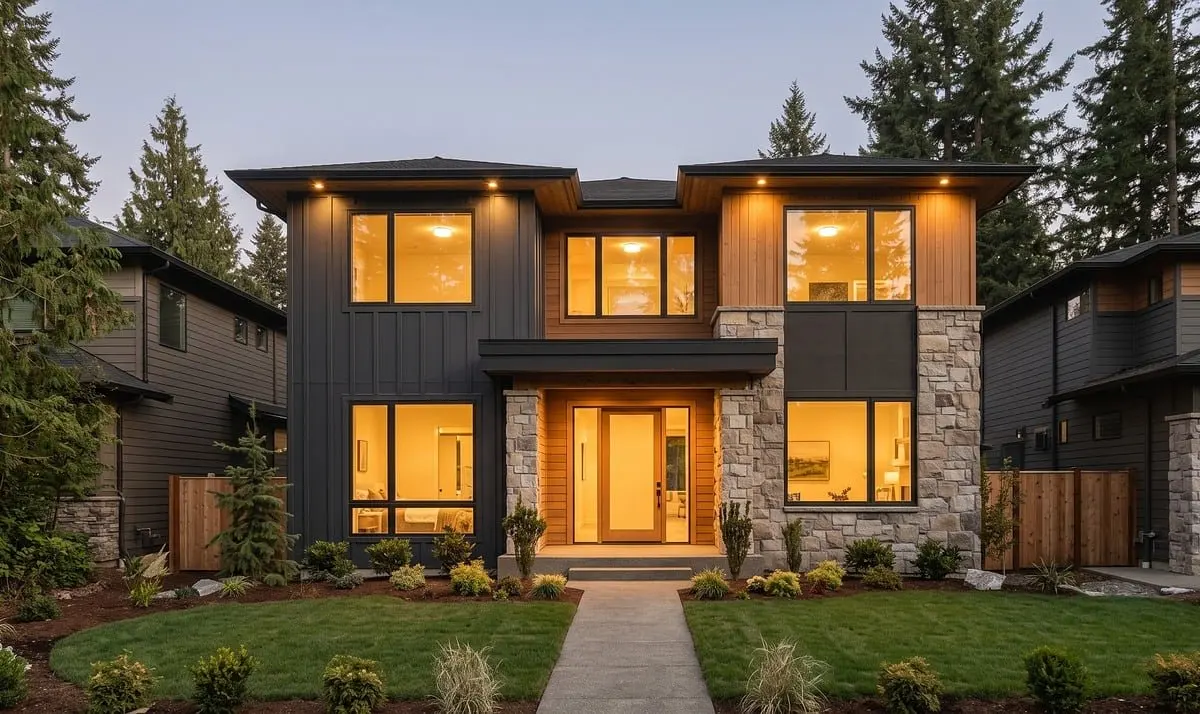
A bright facade floodlight still leaves a dark path. The best modern outdoor lighting ideas for front of house layer scaled door sconces, path lights and plant uplights instead.
The same layering carries into the back garden, and our patio ideas with plants show how planting and light work together there. For the front, the main condition is to plan the route, the door and the beds as separate jobs before choosing fixtures.
Why lighting only the facade falls short
A wall wash shows the house but leaves the walk, the steps and the planting in shadow. Designers suggest mixing sconces, pendants, lanterns, post lights and landscaping lights to build a layered exterior. Intentionally placed landscape lights do three jobs: they illuminate walkways, highlight architectural elements and wash general outdoor areas with light. On a plain modern elevation, with few ornaments to catch the eye, those layers give the front its depth after dark.
Lighting also has a practical side that a facade-only plan ignores. People who try to break into homes avoid well-lit areas where passersby could easily see them, so a visible, lit entry does more than look good. The table below sets three common assumptions against what the guidance supports.
| Common assumption | What the guidance supports | Planning use |
|---|---|---|
| One bright door light is enough | Visitors arriving at night need adequate lighting along their path to prevent trips and slips, and a well-lit entry that passersby can see discourages intruders. | Treat the door fixture as one layer, then add path lighting so the whole approach is lit. |
| Path lights only need to go on one side | The common practice is to install pathway lights along both sides of the pathway. | Specify path fixtures as matched sets along both edges rather than a single row. |
| The porch light covers the steps | Navigating stairs in the dark can be dangerous, and staircase lighting reduces the chance of people slipping. | Give exterior steps their own lighting instead of relying on spill from the door. |
These points follow Cast Lighting’s guidance on lighting the front of a yard.
Door fixtures: scale matters more than style
The most common misjudgement at the front door is size. A fixture that looks fine in a catalogue can look lost against a wide door and its trim, and the door sets the scale for everything else at the entrance.
Sizing wall sconces
A lighting retailer’s rule of thumb is that an outdoor lamp should be about one-fifth the height and width of the doorway, including trim. Its own example pairs a 100 in x 60 in door with a fixture 20 in H x 12 in W. Treat that as a starting estimate to check against the real doorway, not a precise specification.
Oversized doors and post lights
An oversized door changes the answer. Designers note that such a doorway needs larger or oversized sconces or porch lights to feel balanced. If you also plan a post light, the same retailer guidance says it should be as large or larger than the lights at the front door. That keeps the two fixtures from competing and makes the entrance read as one composition.
Path lights, steps and the walk to the door
Path lights exist to get people safely to the front door at night. Unlike a sconce, their job is to show the ground, so they belong low and close to the route rather than on the house.
Where path lights go
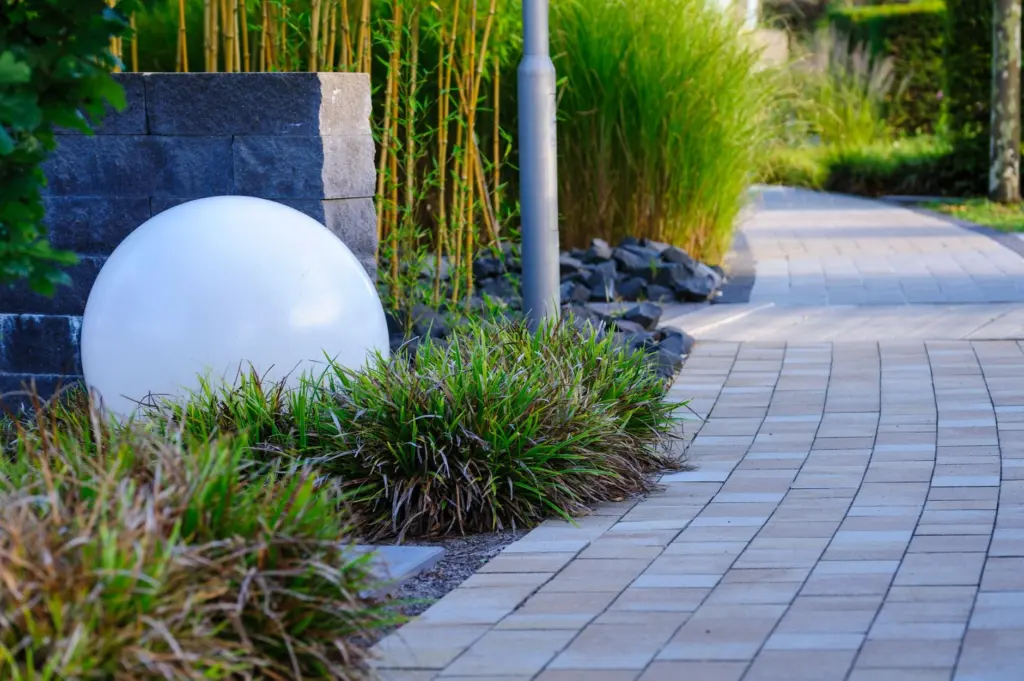
Start at the point where the walkway meets the drive or pavement and work toward the door, placing fixtures along both edges. Add dedicated step lighting wherever the route changes level. Path fixtures also sit beside the beds that usually flank a walkway, so they do a second job of defining where the planting begins.
Spacing without a fixed distance
Placement guidance centres on a pattern, not a distance: lights run along both sides of the path. No single spacing figure suits every walkway, because curves, steps and the width of the beds change where shadow falls. Set the pairs by walking the route at dusk and adding a fixture wherever a turn, a step or the path’s edge falls into shadow.
Lighting plants and trees, not just walls
The front garden is the part of the house that most plans forget. Ground lights create a soft glow that highlights plants, flower beds, tall trees and other garden fixtures. Lighting a few key plants also gives the eye something to rest on between the door and the street, so the facade is no longer the only lit surface.
Uplights and ground lights
Position decides the effect. Placed at ground level, wash lights give upward lighting; mounted under the eaves, the same type gives downward lighting. For shrubs and trees, ground-level uplights suit the job, because they light the foliage and trunk from below. Eave-mounted lights suit a wall or the area under the roofline.
Spotlight or floodlight
Beam width separates the two. Floodlights cast wider beams that suit large areas, while spotlights cast narrower beams. Use spotlights selectively, since they are a type of accent lighting. A single narrow beam on a specimen tree or a feature plant reads as intentional, whereas spotlights on every shrub flatten the effect. Reserve floodlights for broad areas such as a larger bed or a wall.
Keeping glare and spill down
Some manufacturers offer fixtures with Dark Sky lighting designed to direct light where it is needed while reducing light pollution. For a front garden that faces neighbours and the street, that is a useful feature to look for, because the aim is a lit path and lit plants rather than light thrown across the boundary.
Color temperature, bulbs and brightness
A common belief is that the brightest-looking light is the best light. Colour changes the feel of an entrance as much as output does. Cool lighting brightens the entrance, while a warm bulb can create a friendlier mood. For a front door that should welcome people, warm is the safer starting point; reserve cooler light for areas where you want a crisper, brighter look.
Testing Kelvin before committing
Adjustable fixtures make the choice easier to test. One listed LED wall light offers 3000K to 5000K adjustable colour temperature with an IP65 rating, and another listed pair of LED wall lights comes in 3000K, 4000K and 6000K versions. A single retailer’s outdoor collection lists 9 products with adjustable colour temperature. Those are product specifications, not recommended ranges, but they show that you can compare tones on site before settling on one. Choose a single tone for fixtures that are visible together, so the door, path and plants do not look mismatched.
Reading lumens sensibly
Lumen figures vary by fixture, so read them as product specifications rather than targets. A listed smart porch wall light is rated at 1200 lumens, which is a strong output for a door fixture. A path or plant light does not need to approach that figure, because its job is to show the ground or a trunk, not to flood an area. Match output to the layer: brightest at the door, softer along the route and in the beds.
Solar, low-voltage and smart controls
Neither solar nor low-voltage wins outright; the job decides. A listed solar wall sconce is described as 700 lumens, 3000K, dusk to dawn, with 4 brightness levels and an IP65 waterproof rating. That makes solar a reasonable fit for a wall position where running a cable is awkward and a warm tone suits the entrance. For the brightest part of the plan, the door, compare its lumens against the 1200-lumen smart porch light above.
Whatever the power source, compare fixtures on the same stated points: lumens, Kelvin and the waterproof rating. A wet-rated label matters more than the power type, since the fixtures sit in the weather all year.
What smart controls add
Smart controls matter most where you want more than on and off. The listed smart porch light offers a range of scene modes and an IP66 waterproof rating, so the entrance can shift between a bright arrival setting and a quieter evening one. Scenes are most useful when the door, path and plant layers can be set separately, so you can keep the route lit while dimming the accent lights.
Carrying the plan to the rest of the garden
Once the front is lit in layers, the same approach extends along the side of the house and into seating areas. Our guide to Pergola Lighting Ideas: Transform Your Outdoor Space With Cozy, Stylish Illumination In 2026 applies it to a covered structure, and Backyard Fire Pit Ideas That Transform Your Outdoor Space In 2026 covers a gathering spot where low, warm light suits the setting. More ideas for lit entrances, patios and seating areas are collected under Outdoor Living.
Frequently asked questions
| Question | Answer |
|---|---|
| Can dry-rated fixtures be used outside? | No. Dry-rated fixtures are not a suitable choice for outdoor spaces, so check for a wet or waterproof rating. |
| Is one bulb or several better inside a lantern? | A fixture with several low-wattage candle bulbs is preferred over a single bulb, since it gives more light with less glare. |
| What do solar sconces cost? | The solar sconces referenced in one designer guide come in under $100, which makes them a budget option for wall positions. |
| Do smart outdoor lights work with voice assistants? | Some do. One listed smart porch light is compatible with Alexa, Google Assistant and Matter, so check the compatibility line on any fixture you plan to buy. |