A front yard corner often looks awkward because it is seen from several sides. The best corner landscaping ideas front yard plans use layered shrubs, grasses or a trellis, sized to mature height, with sightlines kept clear.
The sections below test the most common assumptions about corner planting against extension and landscaping guidance. They sit alongside our wider set of garden design ideas for the rest of the yard.
Planning around the views
A corner should be designed for the places people actually see it from, not for an imagined overhead plan. Rockleaf Landscaping says a front corner has to read well from 2–3 common views, such as the street, the driveway and the front window, and recommends surveying viewing spots first, usually 3–5 spots in a typical yard. Stand at each spot, note what the corner shows, and give the most-used views priority.

NC State Extension makes a related point: a unified landscape provides a pleasant view from every angle. A bed that looks full from the street but shows bare stems or a fence from the window is only half finished.
Assumptions that cause awkward corners
| Common assumption | What the guidance supports | Planning use |
|---|---|---|
| Buy the plant you like and find a spot for it | Mature height and spread should be weighed before a plant goes in; a full-grown size that is too large can overwhelm the design | Check the mature size on the label against the corner before buying |
| Small plants are always the safe choice | Plants that stay small at maturity may look inappropriate as a background border | Put taller plants at the back and keep compact ones forward |
| The corner only has to look good from the street | A front corner has to read well from 2–3 common views | Check the street, driveway and front window before finalising the plan |
| A solid shrub border is a tidy answer | A border brings the eye to a boundary and makes the space appear confined | Use a screen only where you want to block a view, not along every edge |
The plant-size and border guidance comes from NC State Extension’s landscape design chapter, and the viewing-angle guidance from Rockleaf Landscaping’s corner yard guide.
NC State defines scale as the proportion between two sets of dimensions. In a corner, that means comparing each plant’s mature size with the house, fence or walk beside it. The extension chapter shows a tree far too large for a tiny front yard as an example of what goes wrong when that comparison is skipped.
Keeping sightlines clear
Sightlines are a safety question as well as a style one. Rockleaf advises checking street or driveway sightlines on corner lots, and says front corner ideas should favour clean edging, all-season structure and safe sightlines. Before planting anything tall near the street side, stand where a driver or pedestrian would look and confirm the plants will not block the view once grown.
Screening and visibility pull in opposite directions, so decide which side of the corner does which job. A planted screen closes the angle and blocks unwanted views, which suits the side facing a neighbour or a utility box. The side facing the street junction is better kept low and open. A hedge along both sides trades visibility for privacy, and a continuous shrub line can also make the space feel smaller than it is.
Plants that suit corners
Corner plants need to fit their final size, the light they receive and the effort you will realistically give them. The choice usually comes down to a structural shrub, a soft grass layer and something low to knit the bed together.
Shrubs and plant height
NC State Extension advises carefully considering both the mature height and spread before including a plant in the landscape. No single height suits every corner, so measure against your own house and fence line. Use tall shrubs where you need privacy, since taller plants and trees can create some privacy from the rest of your space, and keep them away from the traffic-facing edge.
If a large shrub or tree already stands in the corner, the extension chapter suggests balancing it with a grouping or cluster of smaller plants rather than trying to match its size. That asymmetrical approach suits irregular corners where a mirrored layout would look forced.
Ornamental grasses
An ornamental grass cluster is the simplest planting for a sunny corner. It gives movement and a softer outline against fences and shrubs, and it works best grouped rather than scattered as single plants. Pair it with a shrub behind it so the corner still has structure when the grasses are cut back.
Groundcovers
Groundcovers matter more than their height suggests. NC State notes that ground covers and turfgrass act as unifying elements in a landscape. Running a low planting along the front of the bed ties the shrubs and grasses together and gives the corner a finished edge against the lawn or path.
Layering the bed to read from two sides
A corner bed is seen from at least two directions, so it cannot be planted like a flat border against a wall. Rockleaf describes a corner lot planting in which plants are layered to read from 2 sides instead of just one. In practice, place the tallest shrub toward the point of the corner and step down in height toward each edge, with grasses in the middle and groundcover at the front.
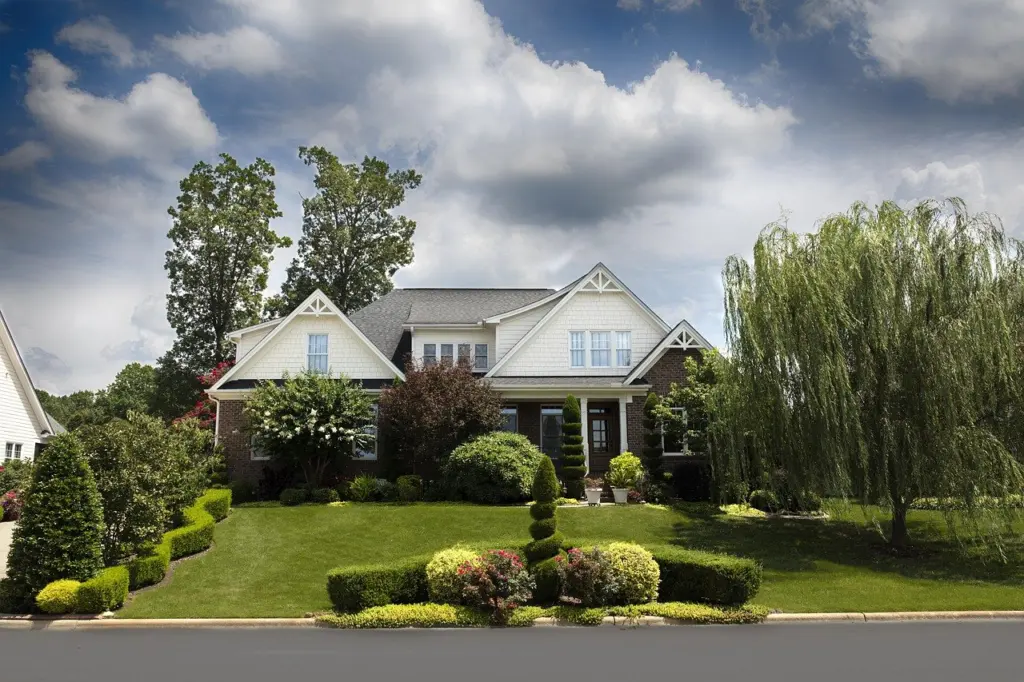
Layering also handles the mistake of choosing only small plants. A tall back layer gives the bed a background, and lower layers in front keep the view open. If you prefer a looser, flower-filled approach in front of the house, the mixed planting ideas in Front Yard Cottage Garden Ideas: Charming, Low-Maintenance Designs For Small Spaces (2026) adapt well to a corner.
Using a trellis in a narrow corner
A trellis suits the tightest corners because it adds height without taking up ground. Rockleaf notes that narrow wedges suit vertical elements like a trellis, and that vertical height solves a tight footprint. It also gives the corner a focal point that reads clearly from the street.
Climbers such as ivy, roses and beans can be trained up a vertical trellis, as Bower and Branch suggests for small corner spaces. Choose the climber to match what you want from the structure: roses for flowers, beans if you want a productive corner. Keep the trellis itself in proportion to the house, in line with the scale guidance above.
Matching a design to your corner
These designs answer different problems, so choose by the corner’s main limitation rather than by appearance alone.
- Ornamental grass cluster: suits a sunny corner where you want movement and low effort.
- Privacy hedge: suits a corner that faces a view you want to hide, provided it stays off the traffic-facing edge.
- Trellis with climbers: suits a narrow wedge where there is more air than ground.
- Layered shrub and groundcover bed: suits a corner viewed from the street and the front window, where it has to look complete from both.
- Built-up planting area: suits a corner where you want a defined, contained bed; Cheap Raised Garden Bed Ideas: 10 Budget-Friendly Builds For Small Spaces In 2026 covers budget builds for small spaces.
Whichever you pick, keep the design simple at the street-facing edge and put the more ambitious planting where it can be enjoyed from the window or door.
Frequently asked questions
| Question | Answer |
|---|---|
| Which corner design takes the least upkeep? | Rockleaf rates an ornamental grass cluster as low maintenance and beginner-friendly in sun. A privacy hedge is rated medium maintenance and intermediate, and a trellis with climbers medium maintenance and beginner to intermediate, per its corner yard guide. |
| What if I cannot plant directly in the ground? | Containers work well. The approach is described as perfect if you cannot plant directly in the ground, and the pots can be changed over time, according to DigsDigs. |
| Why do corner lots feel harder to design? | They carry more yard, more visibility and more pressure than a single-frontage property, as The Coolist puts it, so the planting is judged from more angles. |
| Can hanging baskets or plant walls help in a small corner? | Yes. Hanging baskets, trellises or plant walls can maximize the use of space in a small corner, according to DigsDigs. |