| Condition | What it affects | Planning use |
|---|---|---|
| Soil about 50°F | Extension advice names this as the best time to plant corms | Check soil with a thermometer instead of relying on a calendar date |
| Predicted night lows around freezing (32°F) | Extension advice is to forestall planting | Hold the corms back until the forecast improves |
| Planting too early | Corms can simply rot | If unsure, wait; late planting is safer than early, up to a limit |
| Mild winters and long cool springs | Fall is the usual planting season | Plant in fall for cool-season bloom |
| Colder winters (USDA Zones 3 to 7) | Corms are treated like annuals | Plant in late winter or early spring after hard frosts have passed, and store dormant corms afterward |
These figures come from the extension answer on planting ranunculus corms and the Clemson Home and Garden Information Center.
When to plant ranunculus bulbs depends on soil, not the calendar: set corms out when soil is about 50°F and hard freezes have passed, in fall where winters are mild and in late winter or early spring where they are cold.
Treat this as a companion to the broader When To Plant Bulbs: A Seasonal Calendar For Gorgeous Blooms In 2026 and to your own seasonal garden checklist. Ranunculus are technically corms, not true bulbs, but the timing question is the same.
What the planting date changes
The date you plant decides whether a corm roots in cool soil or rots, so the cost of a mistake is higher than with most bulbs. The extension answer is direct: if planting is done too early the corms will simply rot, and such plantings are better done too late (up to a limit) than too early.
- Too early: Warm soil is the main risk. A grower guide notes that ranunculus dislike soil temperatures above 60°F and rot more easily there. Treat 50°F as the planting point and 60°F as a ceiling to stay under, not as a target range.
- Freezing nights: Extension advice is to hold off when predicted night lows are around freezing (32°F). Check your forecast the week you intend to plant, not only your average last frost date.
- Slightly late: A modest delay costs less than rot. It suits anyone who is unsure whether the soil has cooled enough, but it is not an invitation to plant indefinitely, because the extension answer sets a limit.
- Hot, short springs: A grower in a Piedmont climate reports that spring-planted corms do grow, but quick heat usually makes for shorter stems. If your spring heats up fast, fall planting is the better route to good cut flowers.
Choosing fall or spring planting by zone
Climate decides the season. Clemson’s extension specialists explain that ranunculus grows well in regions with mild winters and long cool springs and is usually planted in the fall, while areas with colder winters should plant in late winter or early spring, after extreme hard frost dates have passed. The extension answer likewise calls planting these corms usually a fall chore.
Mild winters: fall planting in zones 8-10
Yes, you can plant in fall, and in mild climates you should. A grower guide lists ranunculus as hardy in zones 8-10, and a nursery guide likewise puts zones 8-10 on a fall schedule.
Within that range, soil temperature still sets the exact week. The same Piedmont grower, gardening in zone 7b/8a with short springs, finds fall planting best and waits until November or December to put corms in the ground, when soil has cooled into the 50s F. Planting at the first cool snap of early fall is the mistake to avoid, because warm soil is where rot starts.
Cold winters: spring planting in zones 3-7
In colder regions, Clemson says corms are treated like annuals, with dormant corms dug up and stored (USDA Zones 3 to 7). A nursery guide agrees, advising zones 4-7 to plant in late winter or early spring and to lift and store corms so they are protected from freezing temperatures.
The decision here rests on frost dates. Plant outdoors only after the hard frosts have gone and the soil has reached the planting point, then keep planting late rather than early if the weather is unsettled. If you grow other spring bulbs on the same schedule, When To Plant Tulip Bulbs: The Simple Calendar And Tips For Reliable Spring Blooms shows how their timing differs.
Dormancy and prechilling
Corms are not planted the moment they are harvested. The extension answer notes that most corms need to go through a period of dormancy before they can be planted. Prechilling is one way gardeners provide that preparation, so buy corms that are ready to plant and follow any chilling instructions the supplier gives. A prechilled corm still goes in only once soil is about 50°F and freezing nights are over; the dormancy period and the soil-temperature wait are separate steps.
Use these quick rules to pick your route:
- Mild winters and long cool springs: plant in fall, timing it to cooling soil rather than to a date.
- Short, fast-heating springs: favor fall planting even if you sit near the edge of the hardy range.
- Cold winters: plant in late winter or early spring after hard frosts, and plan to lift and store the corms.
Soaking and planting the corms
Yes, soak the corms. Clemson recommends that you pre-soak the corms in room temperature water for several hours. A nursery guide gives a tighter figure, 3-4 hours in lukewarm water, to rehydrate dried corms.
Another grower guide, quoting a handbook, says a soak can run anywhere from 2-12 hours. That is a wide range, so a few hours in plain, not cold, water is a sensible middle choice. Soaking prepares the corm but does not move the date: plant only when soil temperature and the forecast say it is safe.
Bloom timing and aftercare
Work backward from the flowers you want. Clemson reports that corms will typically flower about 90 days after planting, with a flowering period of up to 6 to 7 weeks. That makes the planting date the main lever on bloom time, which is another reason not to rush corms into warm soil.
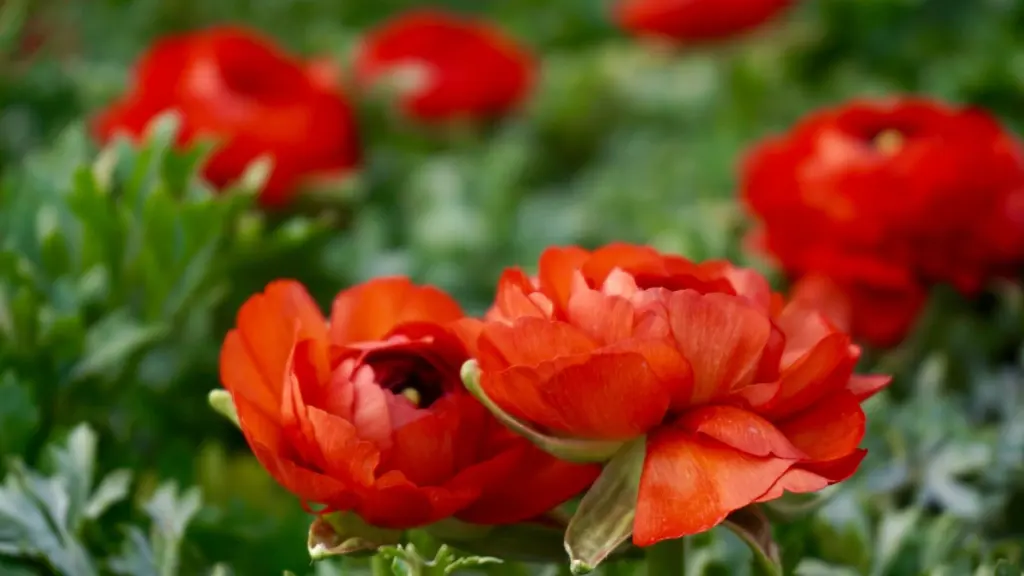
After the flowers finish, leave the foliage alone. Clemson advises that you allow it to die back, or turn yellow, before cutting. The corm is a modified swollen stem base that stores energy reserves, so the leaves are feeding next season’s growth. In zones 3-7 that is also the point at which dormant corms are dug up and stored.
Frequently asked questions
Which end of the corm faces down, and how deep do I plant it?
Plant the claw end facing down. Clemson gives a depth of 2 to 3 inches and spacing of 3 to 6 inches apart. A nursery guide suggests about 2 inches deep and 4-6 inches apart.
Can I start corms indoors in a cold climate?
Yes. A nursery guide advises starting them indoors 8-10 weeks before your last expected frost date in colder zones, then moving them out once frost risk has passed.
How much sun do ranunculus need?
Choose a spot that gets at least 6 to 8 hours of sunlight each day.
What exactly is a ranunculus corm?
It is a modified swollen stem base that stores energy reserves, according to Clemson’s gardening guidance. That stored energy is why a healthy corm needs dry-season dormancy before planting and is vulnerable to rot if it sits in warm, wet soil.